The Monstrous Civilizations Of Delos
The Monstrous Civilizations Of Delos
I Wasn’t Sure About This Until I Saw The Chapter on Succubus VD
Now You Get To See It, Too
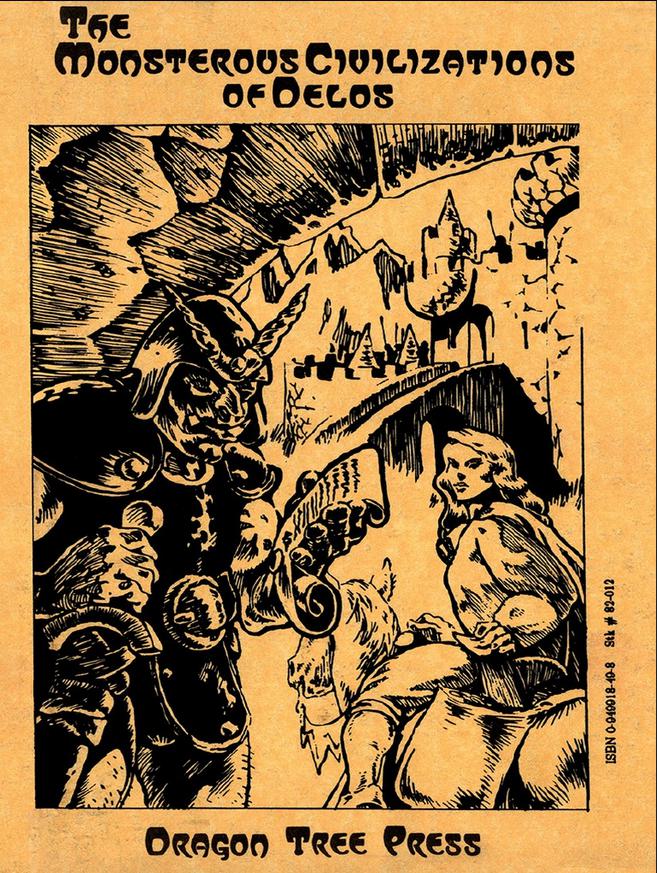
Cover of the Second Edition
I tend to not care about setting information in my RPG material, preferring to write my own. OTOH, I love collecting any “old-school” books from the early eras of gaming. The Monstrous Civilizations of Delos from Dragon Tree Press is actually a bit late in the period – my copy was printed in 1989, around the time of AD&D 2e and a few years shy of when Vampire: The Masquerade would signal a cultural shift in TTRPGs, from “undateable math nerds sitting in dim basements rolling Euclidean dice” to “undateable theater nerds sitting in basements rolling 10-sided dice”. The world turned upside down, surely!
Where was I?
Ah, yes. The Monstrous Civilization of Delos. This was a “little brown book” style product, square-bound, which means I am going to be using a low quality scan for screenshots, as there’s no way I’m cracking the dried glue on this to press it to the scanner (90 frickin’ bucks for a copy at Noble Knight!). While some other Dragon Tree books, such as the Dragon Tree Spell Book, the Handbook of Traps and Tricks, and the Book of the Dead, were more mechanical, this one is mostly fluff and worldbuilding. But is there anything “mineable” in it (other than succubus VD)? We’ll see!
Opening Up
OK, the first page is… huh.
Very unusually, there seem to be significant differences between the Second Edition I own, and the First Edition I have a scan of. Huh.
Might as well discuss them first.
The Second Edition has a layout that is cleaner, more professional: The hard-to-read cursive font is gone, headings are more distinct, supplementary text is boxed. The actual content is mostly the same, though I’m sure I’ll stumble on discrepancies. One notable difference is the “Adventurers vs. Alcohol” chart. In 1E, it uses a series of letters (“MISED”), for Mild, Intoxicated, Severe, Extreme, and Dead Drunk. In 2e, for reasons unknown to me, they replaced these with dingbats: Deltas, triangles, arrows, pink hearts, green clovers, blue diamonds.. no, wait, that’s Lucky Charms. Anyway, it’s an odd choice that reeks of “Because we can”, a constant element of the early DTP (that’s “desktop publishing”, pervs) era.
But I am ahead of myself. Let me get behind myself. Erm. As it were. And speaking of were, where was I? Ah, yes. Starting out.
We start out with intoxication, which is odd, as that’s usually how things end up. Badum-bum. I’m hilarious. Anyway, there’s a chart cross-indexing race and level, and please not, “Level” goes to 50. This ain’t no “kobolds and copperpieces” fantasy fucking Vietnam. This is real old school, which means, “Over the top”.
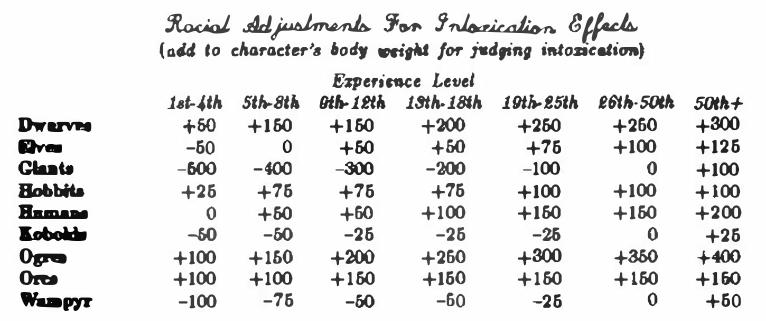
Yes, It’s A Crappy Scan. You Want Better, Buy Me A Second Copy And I’ll Scan My First
The text after this notes that Wampyrs, which seem to be what Elmer Fudd calls Dracula, are “cheap drunks”, while dwarves hold their liquor well. Good to know for some kinds of games, I guess.
The next chart (which I’m not going to copy) cross indexes weight (as adjusted above) by drinks/hour to give a value on the MISED scale. Your place on this chart also determines how bad your hangover will be. You know, between the hangovers and the forthcoming… eventually… magical VD rules, this book is practically a WW2 Training Film!
Then, we get to “Preventions, Cures, and Other Remedies”, which has a very Hargravian feel to it, particularly the later Arduin books, which I haven’t covered. It’s not clearly explained what these do, but reading carefully, I believe they counteract alcohol for the specified duration. As usual, a few highlights:
Carter’s Little Livelier Pills: Take 1-3 pills per 200lbs body weight, they work for 20+1d10 minutes but induce (5% chance) hiccups. Among the cheapest items.
Noralin’s Crinis du Canis: I think that’s a pun on “hair of the dog”? Doesn’t prevent the effects of alcohol overall, but prevents drowsiness and lessens hangover effect, though by how much is not specified.
Rovarian’s Emetic: You take it and you vomit up everything in your stomach, including any unabsorbed alcohol. It doesn’t do anything for your current state. “The taste will not be described here.” Yay.
A Brief Ending
This is shorter than usual, but I need to get back in the habit of posting something. It’s possible I will write more tomorrow, and equally possible I won’t, so, I’m going to post this, and if I’m inspired, extend it tomorrow, in which case, you won’t see this.
Not The End!
Huh. I’ve never really extended a published article before! I can’t save drafts without unpublishing, and, who knows? There’s a small but non-zero chance someone might click the link to see this article, then receive a 404 Not Found error, and conclude this site has gone the way of all digital flesh. Therefore, in the unlikely event anyone is reading this, they may see strange changes appearing and disappearing as I work my editorial magic, shaping this text with alterations both subtle and gross, until it achieves perfection! (To be accurate, “slightly less imperfection’.)
A Cure For What Ale’s Ya
That was a punne, or playe on wyrds: As these are hangover cures, I used “Ale”, as in the beverage, rather than the expected term “ails”, as in “to cause discomfort or sickness”. I hope you all appreciate my wit.
Arcia’s Palative: This comes in the form of a scroll, with a “Use With Caution” warning. It will remove all effects of alcohol, but has a 10% chance of being addictive. Damn. You don’t get hooked on smokeleaf in Rimworld that fast!
Framu’s Accelerator: Rather nastily, doubles the effect of a hangover but makes it last half as long. Well, that’s implied. As is par for the course with these supplements, it actually merely states “lessening duration” with no specified degree.
Mogro’s Elixir: For 1 GP a pop (more expensive than most) it turns you into a cartoon character, w/steam coming out of your various orifices (only those on your head… probably), your eyes turning bright red, and so on. This lasts 1d3 minutes, then you’re cured. It is “hard to find”, so, probably not worth wasting one on a practical joke during a meeting with the High Lords of the Mountain Clans. Probably. It would be really funny, though.
And then there’s the Amulet of Displaced Misfortune. Ten years before Pratchett introduced us to Bilious, the Oh God of Hangovers, this magic item will let you pass your pain to someone else. You must, however, convince them to finish their drink after you have surreptitiously dipped the amulet in it, whilst acting excessively chummy towards them. Intriguingly, there’s no price or rarity given for this item. I guess either the GM lets you have it, or doesn’t. It could be a good adventure seed if a PC is victimized by an NPC using it.
Your Tragic Backstory
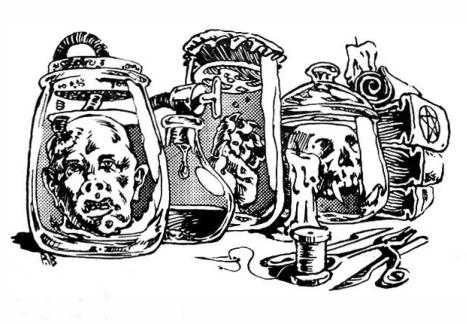
This Is On The Apprenticeship Page. Don’t Flunk Out of Alchemy School, Kids!
Next follows a series of charts for randomly determining your character’s background. Like all such charts of this era, there’s a lot of assumptions built in, such as “Neither orcs nor halflings can be Nobles”. Also, ogres are biz-zay! You have a 30% chance of having 7 siblings, and a 10% chance of 1d12+7! Across all the listed races, there’s a roughly 2% to 6% of being an orphan. Oddly, orphans don’t have siblings, unless I’m grossly misreading the chart. A ‘Noble’ result means you roll again for siblings (I suppose you can be a Noble and an Orphan), but Orphans just go to the adoption table.
Oh, Ogre Nobles must first survive “The Wild Time”, which is covered under “Ogre Culture”, which we’ll get to… eventually.
Side Note: It is twice as likely for an orphan orc to be adopted by an elf than it is for an orphan dwarf.
Next is “General Environment” (City, Town, Village, Rural) each divided into Coastal or Inland. This, in turn, leads you to environmental influences, which, by inference, allows you to roll on multiple tables – for example, a Coastal City allows you to roll on the “Urban” table… I guess… there’s no “city” table. Does “Urban” mean “Anything Not Rural”? It could, I suppose, as there’s a “Rural Only” chart. There’s also a chart for “All Ports”, which includes Cities and Towns, but not Villages or Rural, which can be Coastal, but not Ports. Lastly, the vessel with the pestle has the pellet with the poison. Get it? Got it. Good.
There are tables for Rural and Urban Apprenticeships, and, once more when looking at Old School, there’s a bizarre mix of assumed systems. For example, on the Rural chart, you can end up with “+3 with horses” or “60% Tracking Skill”, neither of which actually tie back to broadly accepted core mechanics used “in most roleplaying games D&D”. (Another Side Note: The Monstrous Civilizations of Delos doesn’t even have that handwave verbiage on it. It does not give any indication what it’s for, that it’s a supplement, etc. I think the assumption is that the ‘trade dress’ — a digest sized book with a brown cover and a generic fantasy image on the cover meant “D&D Supplement”.
The Urban Apprenticeship chart has more, and better, results than the Rural, showing the Coastal Urban Elites were controlling the “Off-Brand D&D Supplement Business” even then! Among other things, you can roll “Locksmith”, giving you a 75% change to pick locks. A D%D thief of the era had a 25% chance at 1st level, and wouldn’t hit 75% until 11th level! A Jurist has a “15% chance to win arguments”, while a Potter has “no special skills”. Stupid Potters. Always making pots!
OK, I’ve just about tripled the length of this from yesterday, which makes it a respectable article. I’ll get back to this.. whenever. As usual. I promise, though, the VD rules are coming!
Super fun!