
Gangster (FGU)
Gangster
Because In The 1970s, Everyone Was Trying To Find The Next Big Genre
As It Turns Out, Prohibition Gangs Weren’t It
TSR Tried Twice (Somehow Calling The 2nd Edition 3rd Edition)
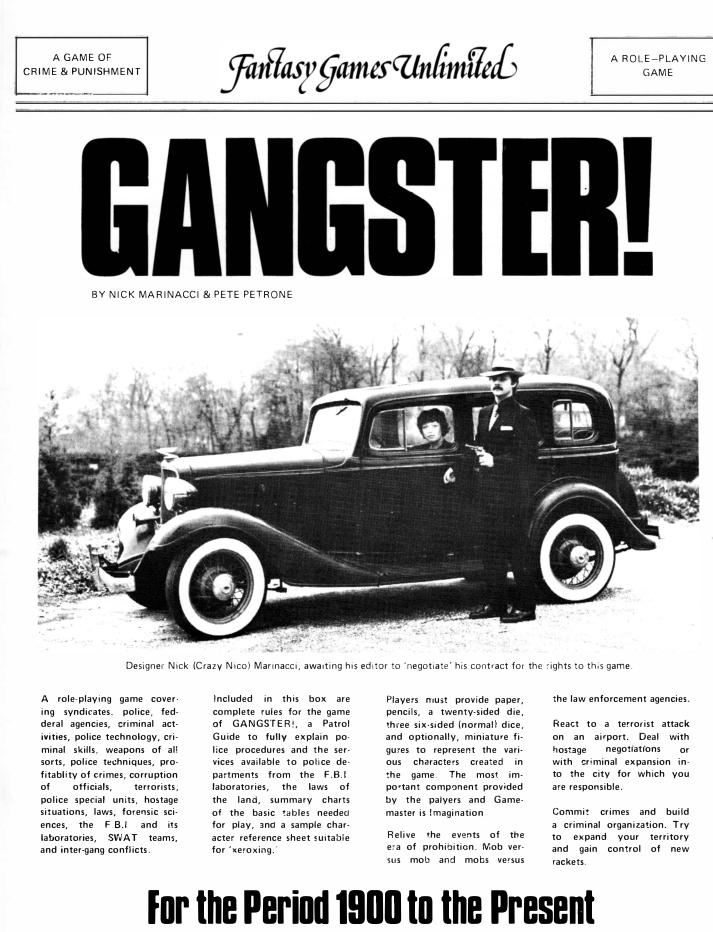
Very Few RPGs, In Any Era, Have Two Columns Of Text In Small Type On The Cover
So anyway, I was in the den, trying to figure out what the cats were staring at in the back yard, and noticed I had “Gangster” from FGU in the pile of “Boxed Games I Moved Upstairs For Some Reason”. I have some unexpected time off, so, I figured, why not? The great thing about having a blog no one reads is you never have to worry about whether or not an article topic is of interest to your audience, because you don’t have one! Freedom!
As the headers say, the late 70s/early 80s were a time when a lot of publishers were trying to find a new genre they could dominate the way D&D dominated fantasy and Traveller dominated sci-fi and… well, those were the only genres sufficiently popular that there were enough competing game systems that you could meaningfully discuss which one was “dominant” and which one wore the gimp mask. (It will turn out the third genre was Sexy Angsty Vampires, but that didn’t happen until the early 1990s.)
FGU, or Fantasy Games Unlimited, had a “throw everything against the wall” philosophy, with games about samurai, superheroes, pul… Oh, wait. Superheroes! That was the other genre where there were competing games! FGU’s own “Villains and Vigilantes” was the one with the whips and stiletto heels for a while, until Champions game along in 1981. I digress. Where was I? Mmmm, whips and stiletto heels… no, no, FGU’s panoply of games! Pulp, pirates, post-apocalypse (loved Aftermath), fencing (the kind with swords, not the kind with pawn shops), and some I’m sure I’ve forgotten. Among this vast range was “Gangster”, which, if you recall all the way back to the heading, is the topic of this post, to the extent any post I write has a “topic” vs. “an arbitrary starting point for a stream of consciousness ramble”.
Gangsta’s Paradise
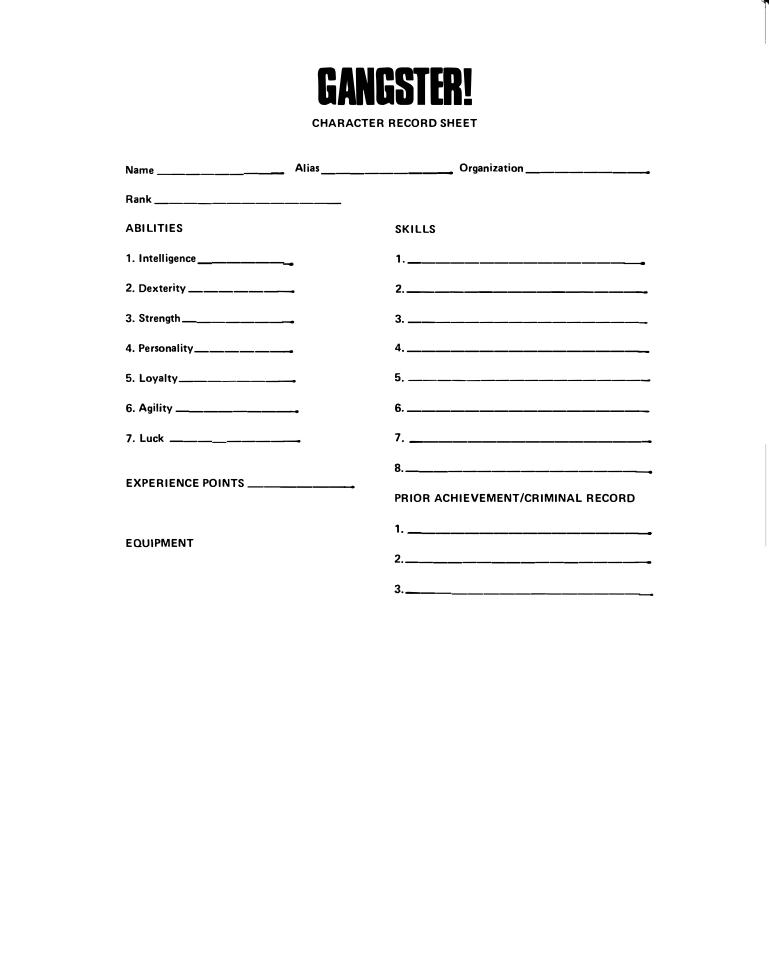
Clean Lines, No Excess Verbiage, Plenty of White Space
I hope people appreciate I looked up the exact title and changed my original heading of “Gangster Paradise” to the correct form you see now. It’s this kind of precise attention to detail you expect from at least one sentence per blog post, written when the adderall is kicking in juuuusssst right. The rest is a confused, incoherent, ramble.
Which we shall begin…. now!
The boxed set has two rulebooks, the core one being 50 pages, and the “Patrol Guide And Law of the Land” book being 16 pages. The box also contains a d20, d12, and d4 (the d12 and d4 are the classic “Holmes Basic” ultra-mushy plastic, the D20 a typical late-70s “high impact”), a thick yellow stock paper sheet of charts (de rigueur in FGU boxed games), and a character sheet that is a masterpiece of minimalism. Lastly, there is a small portion of the wrapper from a Kellogg’s Nutri-Grain Bar, which I suspect was not a standard inclusion. How it got into a game box I do not recall opening shall remain a mystery for the ages.
Although the cover image is of a 1920s car, and the fact that when most people think of “gangsters” (at least in the 1970s), they think of Al Capone, “A Piece Of The Action“, and so on, the game covers a timeframe from 1900 to the present (1979). As you might guess, the 50 pages of rules cover this ~75 year timespan with the precision and detail of a book report written an hour before class, based entirely on the book’s front cover.
Damn It Feels Good To Be Roll Up A Gangster
“Obviously, to play GANGSTER! one must create a character whose actions he will control during the game”, state the rules. Well, yes! Obviously! It’s astounding it even needed to be said! If I said this involves rolling 3d6 and summing them multiple times to produce a set of somewhat familiar (Intelligence, Dexterity, Agility, Strength, Personality, Loyalty, and Luck) attributes, would you be surprised? (Well, you might be, as FGU often had rather baroque systems. But not in this case. You are given the option of rolling them in order, rolling one at a time and assigning it to an attribute, or rolling all seven and then assigning them. There are no options for shifting the bell curve, such as the common “4d6 take the 3 highest” method, though there’s no real reason you couldn’t.
I’m just gonna do 3d6 in order. (Note that if all I had was the box set I purchased, I’d have to go find some six-siders, as they were not included. It was assumed, at the time, everyone owned either Monopoly or Risk. I think it was required by law.)
Intelligence: 10
Dexterity: 12
Agility: 9
Strength:10
Personality:11
Loyalty:13
Luck:5
The “Luck” of 5 seems to have retroactively affected my rolls.
Reading on a bit, the game encourages non-random assignment (ah, well), and notes that unlike in many RPGs, “Gangster!” is competitive, implying players are expected to have a mix of criminals and law enforcement among them, with the GM, presumably, acting as arbiter for their conflicts. As interesting as this sounds in theory, my experience is that such “PVP” style games rarely end well. If you want to do that, play a 1-1 minis combat game (as it happens, I am reading the “Necromunda” 1e rules now, for funsies), with a referee conducting an extended campaign to create a cohesive story linking the battles.
But alea iacta est, or more correctly, the three dice have been cast, and so, we go on.
A Very Particular Set of Skills
After you roll your attributes, and decide if you will be a cop or a robber, then you see if you qualify for any skills! (Note that attributes are not defined until after you roll them, either.)
I qualify for… no skills. Not a one. The closest I came is Wheelman, but my Agility is too low.
Well, those are the criminal skills. Maybe I qualify for law enforcement skills?
I can start automatically with 1d3+2 skills (assuming I meet the qualifications). I roll well, so I can have 5 skills… if I have the prerequisites for that many. (I should note that even if I’d chosen to arrange my attributes, my overall low scores would still keep me out of most skills.)
I can take Level 1 Ballistics Expert, Level 1 Drug Expert, Level 1 Arson Expert, and… uh… that’s it.
Those skills allow the player to gain “clues” from the GM if they roll below their Intelligence on a d20, with higher ranks in the skills offering a great big -1 to the roll. Except Arson. Arson only has one rank, which grants the -1 “bonus”, but any LEO can gain clues about arson by rolling under their Int. I’m not sure why this wasn’t a universal system for skills (anyone can try, each rank grants a “bonus”). For that matter, the “rank 2” of the skills requires higher Intelligence to begin with, so they already have a de facto ‘edge’.
(For no reason, I should note that Ballistics Expert requires an Agility of 7. So you don’t butterfingers the shell casings? But that’s covered by Dexterity. Agility is for whole-body motions, like recovering from a fall or doing gymnastics. Shrug. Forget it, Jake. It’s Old School.)
Gangster! has a level system for LEOs, of course, divided into several categories with slightly differing rates of advancement. It’s interesting to note that being a Sheriff requires only 450 xp (and there’s only 4 ranks in the Sheriff’s Department), while being Chief Inspector of a Large City PD requires 5000 xp! 450xp would only get you to Sergeant in the PD. I think the game designer had beef with their local sheriff.
Lethal Weapons
I am just capable of making Sharpshooter (the second level of pistol skill). I can also use a shotgun, but do not qualify for a bonus. Or… penalty? I think this must be a roll low system, as higher ranks of skill with a weapon give you a larger (smaller) negative modifer. That is, my Sharpshooter skill gives me a -3, while Marksman, the first level of skill, provides a -1.
But now I’m looking at the Close Combat rules, which definitely have a “higher is better” feel to them. However, reading on to the gun combat rules (the actual mechanics are in the middle of a paragraph in a locked filing cabinet in a disused lavatory with a sign on the door reading ‘Beware Of The Leopard’), it is, indeed, a “roll under” system. You must roll less than your Dex on a D20.
Let me emphasize this for the people who think “old school” games meant simple and clean rules. They. Fucking. Did. Not. The essence of real Old School is totally incoherent and contradictory subsystems in wildly varying levels of detail based on whatever weird obsessions the designers had, so you could end up with six pages of rules (in very small type) for shoeing horses and have “Naval Combat” be a paragraph reading “Count up all the ships, add 1d6 to each total, higher number wins. Add +1 to the side with the most horses on board. +2 if the horses are shoeless. Sexy, sexy, naked hooves. Mmmm… hooves.”
As an actual example from this game, there is no consistent pattern to how skills work. “Interrogation” has a half page (and when you remember the whole game is only 50 pages, that’s a lot) of custom mechanics and modifiers, while, as noted above, Ballistics, Drugs, and Arson together occupy about the same amount of space and just have a “roll under your Intelligence” mechanic.
So far, Intelligence is the prerequisite for every LEO skill. This is funny when you remember a Connecticut PD once went to court to justify discriminating against candidates who scored too well on an IQ test.
The “Negotiation” skill is not available until the 1970s. I thought you might want to know.
All About The Benjamins
The header is deceptive. There are no Benjamins. Rather, there’s an abstract system for acquiring gear.
Following 10 pages or so of rules about combat, cover, explosives, and so on, we get to… sort of… equipment. If a gang wants something, the GM rolls a D20, which in turn is cross indexed to determine the percentage of the requested items available (as an example, if you want five guns, and the result, after all the many modifiers, is 80, you get 80% of what you want, or 4 guns), or if the request is for a single item (such as a speedboat), the percent chance of it being available. One chart, two mechanics!
(There’s a lot of other folderol involved, all of which makes it seem like Gangster! really did have roots in a 1:1 miniature campaign game before becoming an RPG. This is not entirely surprising. The late 70s were a time of rapid evolution between wargames and role-playing games, and there were quite a few dimetrodons1 running around, if you get my drift.)
Cops just get what they want, based on the timeframe. The charts are only for gangsters.
Crime Pays If You Roll Well
There is then a section on the history of law enforcement and how different US regions organize their forces, followed by a several pages of rules on running various criminal enterprises (and the occasional criminal Defiant or Voyager), from prostitution to gambling to bootlegging. Oddly, nothing about protection rackets, which were and are a very common way to make money for organized crime.
The second booklet is mostly facts about police, including things like the contents of an emergency service truck. In the long long ago, in the before time, this was actually useful to have. There’s also simplified summaries of US law regarding major crimes.
And, uh, that’s it. I’d actually finished chargen without realizing it. You don’t seem to make a lot of choices, except to be a gangster or a lawman, and, if you use the optional methods for assigning attributes, where to assign them.
Given how important those attributes are, I would have written the rules like this:
a)No “roll in order” option, period.
b)Presented skills first, so you could see what attributes mattered.
c)Then you roll and assign stats.
But, hey, it was 1979. Game design was not science, nor barely art, but more a kind of alchemy, where people just mixed random things together and hoped they didn’t explode.
1 “They’re kind of mammals but they look like reptiles
But I bet that difference never bothered them”
Hey, your blog has at least one reader.
Good to hear! Assuming I’m not imagining you in a fit of depression-induced hallucination!